
Why Multi-Tabling In Poker Is Overrated
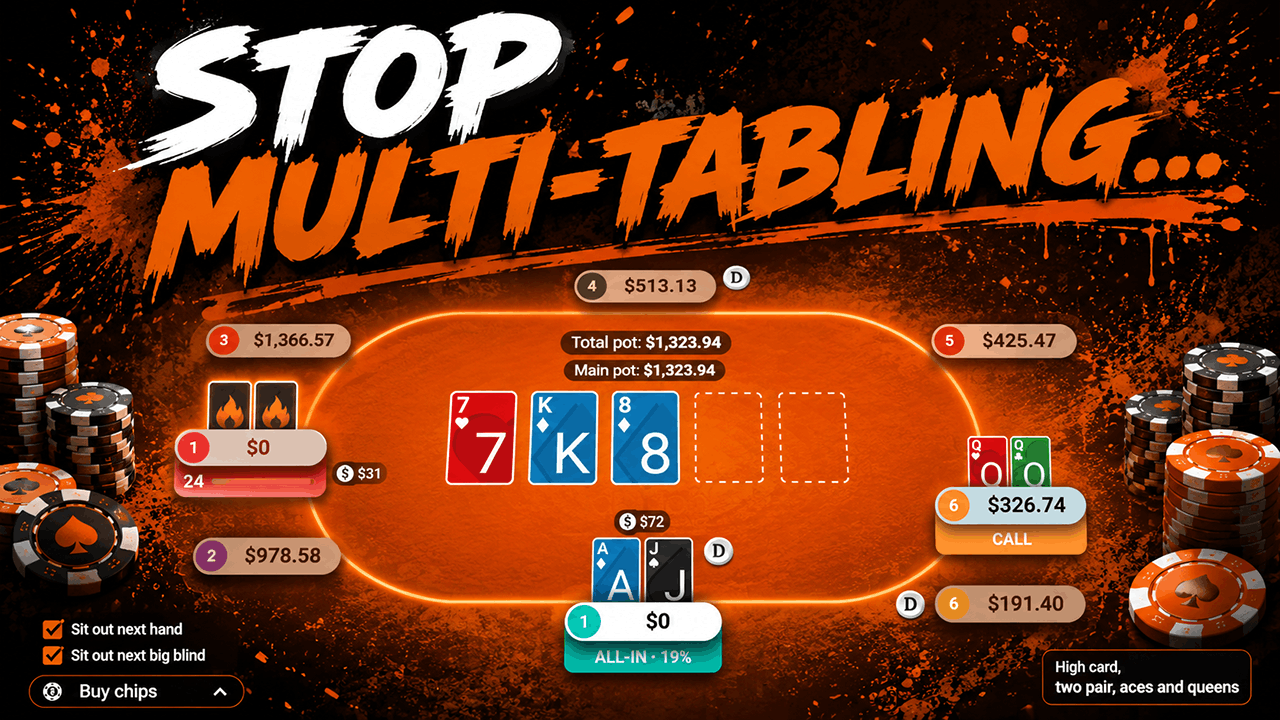
Yes, I am going to come out and say that multi tabling is overrated. I honestly think the sweet spot playing online poker is 2 tables at a time. The issue is that adding 4 or 6 plus tables makes it almost impossible to focus and pay attention to what is going on in each hand.
And guess what happens then? You make mistakes. In this update I will explain why multi tabling is not as glamorous as people make it out to be.
The Myth: More Tables = More Profit
The logic to this sounds simple. More hands per hour, more rakeback, and obviously more money to be made. The issue is that even if you are playing low stake games win rates will go significantly down because your decision quality deteriorates.
Let me repeat that one more time, your decision quality deteriorates. The issue is that mistakes become way more expensive and more frequent when you are overloading your brain to play 4 tables or more at a time and still think you can play solidly. For a small percentage of players maybe they can. But for most the math never adds up the way we imagine it too.
Auto-Pilot Poker Is a Dangerous Habit
Another problem is that going into full robot mode sounds good at first until you see it doesn’t work long term. Sure, maybe if you play a boring ABC GTO style it can work for a while, but something always goes wrong.
You start clicking buttons without thinking deeply and ignore table dynamics. This leads to reduced creativity and later finding it difficult to adapt to tougher games. Essentially becoming a robot at the poker table only works for so long. Eventually it fails.
Fewer Tables Often Means a Higher Win Rate
This is what I’ve noticed playing online poker over a large sample size. I’m talking about hundreds of thousands of hands. When I keep things at two tables max that’s where I get the biggest edge. And I typically play mid stakes 500nl to 1000nl only. When you play slightly higher stake games you don’t need to generalize and force insane volume to make good money. Sure, the competition is harder, but when you really focus on the little details going on in each hand that’s when everything flips. You open your game, bluff more, and make good lay downs when you feel you’re behind.
The Mental Fatigue Problem
No one ever talks about this when they imagine multi tabling 16 tables at a time. But fatigue is a real thing. When you’re seeing hundreds of hands per hour what often happens is increased stress and burnout. And literally no one ever talks about this.
When you play too many tables at a time you have constant time bank usage, miss action, and feel mentally exhausted after sessions. Basically, you can’t sustain playing over a large enough amount of time to even make playing viable. And the burnout thing can happen a lot faster than most people even realize.
How Many Tables to Actually Play?
For most online poker players, the ideal number of tables is surprisingly low. While some grinders boast about playing eight, twelve, or even twenty tables at once, that approach isn't optimal for the average player. Two tables is often the sweet spot.
With a single table, you can pay close attention to every hand and every opponent, but the action can be slow. Long stretches of folding may lead to boredom and reduced focus. Adding a second table solves this problem by keeping you engaged without overwhelming you. You see more hands per hour, stay mentally active, and still have enough time to make thoughtful decisions.
Once you move beyond two tables, the drawbacks start to appear. It becomes harder to track player tendencies, identify weak opponents, and adjust your strategy. Instead of actively thinking through each spot, many players slip into autopilot mode and rely on standard plays. That can be costly, especially in today's tougher online games where exploiting mistakes is often the biggest source of profit.
When Multi-Tabling Does Make Sense
For all the criticism surrounding multi-tabling, there are situations where it can make sense. If you're an experienced player with strong fundamentals and a proven ability to make quick decisions, adding extra tables can increase your hourly earnings. Multi-tabling is also more effective in softer games where opponents make obvious mistakes that don't require deep analysis to exploit. Speaking of softer games, you can find some on Pokerstacked.
Another scenario is when rakeback or loyalty rewards make up a significant portion of your income. Some professional grinders intentionally sacrifice a small amount of win rate in exchange for generating more hands and earning additional rewards. In these cases, volume becomes part of the overall profit equation.
However, even when multi-tabling is justified, there is a limit. Adding more tables should never come at the expense of making costly mistakes or missing profitable opportunities. The goal isn't to see how many tables you can handle—it's to maximize your hourly profit. For most players, that number is lower than they think. If your win rate drops sharply as you add tables, you're likely better off scaling back and focusing on quality over quantity.
Final Thoughts
I think multi tabling in general isn’t a bad thing because I do it myself. It’s just that most people take it way too far and that’s when the problems start. You just can’t play good poker against decent players when you start stacking 4 plus tables at a time. In the short term maybe, it works out for a while. But what often happens later is decision fatigue, poor decisions which lead to losing sessions, and eventual burnout of not even wanting to play anymore.
I really believe the sweet spot for doing this is 2 tables at a time and really paying attention to what’s going on in those games. If you can afford to play mid stakes that’s great, but even if you’re playing low stakes I think scaling down will ultimately help you out in the end especially when it comes to seeing your win rate go up for the time you put into this. Just take it on anyway.