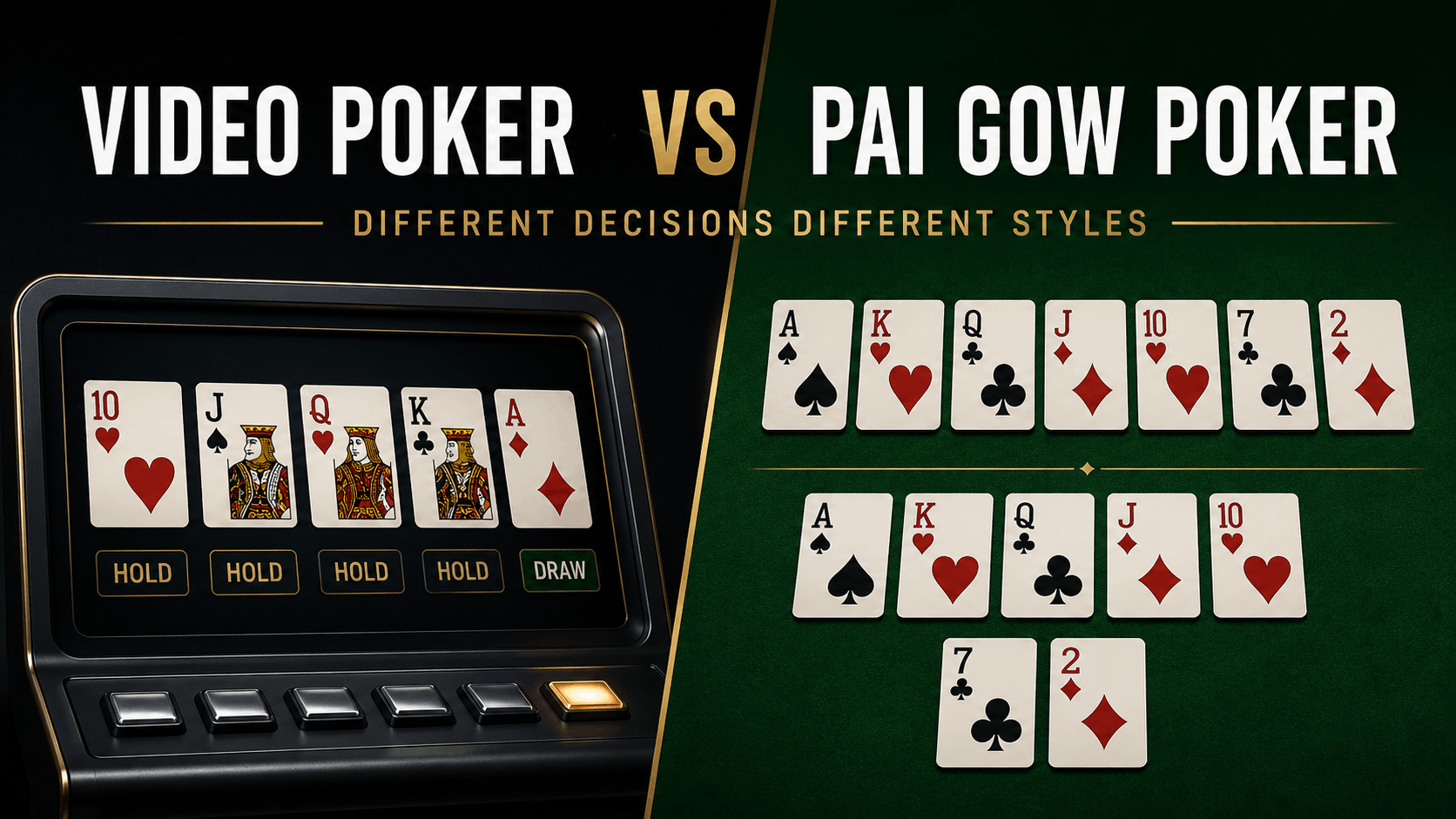
Video poker and Pai Gow poker share familiar hand rankings, but they are very different games, and they train different instincts. One asks which cards deserve to stay. The other asks how 7 cards should become 2 separate hands.
Let me guess, you’ve seen Deuces Wild video poker at the casino, heard someone mumble about it being “easy money,” and now you’re wondering if it’s really that simple. Well, kind of, but only if you actually know how to play it right.
In a world where casino games are constantly evolving, few titles have stood the test of time like video poker. Since its humble beginnings in the 1970s, video poker has carved out a unique space in both land-based and online casinos, offering a satisfying balance between chance and strategy.
Video poker may not always make headlines, but it continues delivering value for many players. One of its most significant advantages is that it gives you complete control over the pace. There is no countdown timer, no opponents waiting on your next move, and no betting dynamics to worry about. This frees you to concentrate purely on the hand in front of you.
In the 1970s, primitive video poker popped up in casinos across Las Vegas, offering players a chance to enjoy a version of 5-card draw in digital form, albeit on a basic machine. Since then, video slots have evolved and are now a staple in both casinos and online casino platforms.
Also known as poker slots, Video poker should not be mistaken for the popular slots. This game actually has some similarities to slots. However, unlike slots, it is not entirely a game of luck. A level of skill is needed to do well in this game. The implication of this is players have a better chance of
influencing the game.
Video poker is a single-player game played on a computerised console resembling a slot machine. Traditional poker is a multi-player card game that is played with a deck of 52 cards. In video poker, the player is dealt five cards and has the option to discard one or more of them in exchange for new cards.